
Content:
Indicolite is a blue or blue-green tourmaline, colored by the presence of iron (Fe).
Its palette ranges from light sky blue to deep, saturated dark indigo.
The finest indicolites come from Brazil, Afghanistan, Namibia, and Mozambique.
These tourmalines typically fall into Type I–II clarity, meaning they are characterized by good transparency and purity.
Indicolite displays strong pleochroism: as the angle of light changes, the hue can shift from blue to blue-green.
Stones from Brazil and Namibia are particularly noted for their exceptionally clean structure and stable, even color.
Indicolite in Asscher Cut: The Architecture of the Blue Abyss
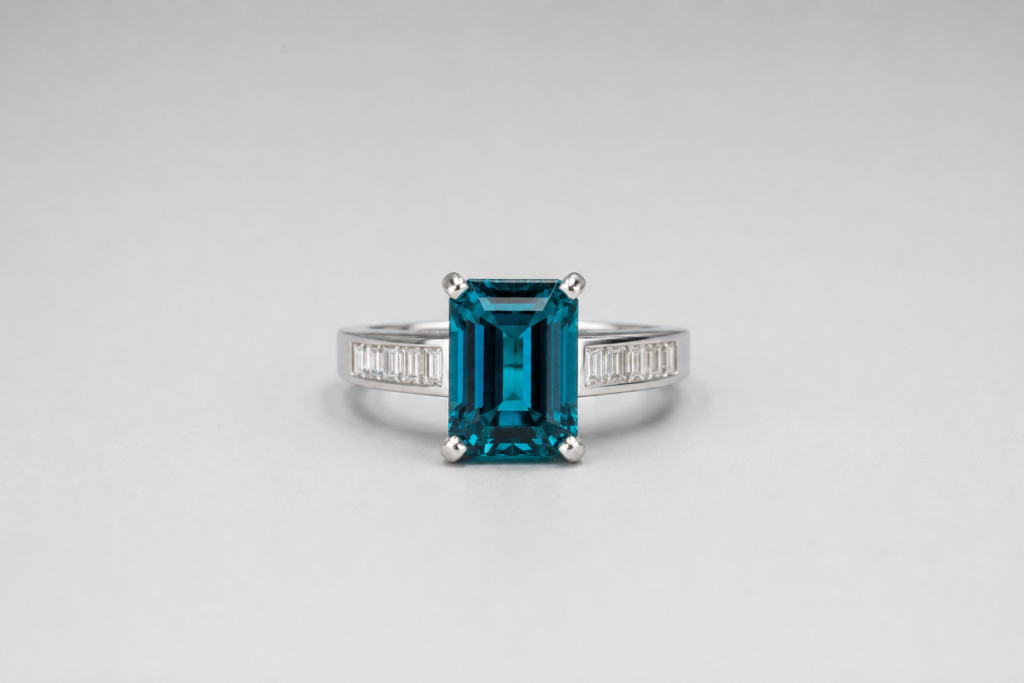
Before you is a magnificent specimen of one of the rarest and most prized tourmaline varieties Indicolite This stone captivates with its deep, saturated blue, in which one can sense the tones of ocean waves and twilight sky. Unlike sapphire, the blue of indicolite carries a distinctive “neon” electric quality and a subtle green undertone, lending the stone a unique, almost mystical aura.
Particular attention is drawn to the chosen cut — the Asscher This is a square step-cut variety with cropped corners, which transforms the crystal into a true work of geometric art. Unlike classic round cuts aimed at maximum brilliance, the Asscher is designed to reveal the very soul of the stone.
Thanks to its wide, open facets and high crown, a celebrated optical effect is created inside the stone — the so-called hall of mirrors The eye seems to fall into an endless enfilade of glowing steps receding into the depths of the blue crystal. The stepped facet structure reflects light rhythmically, producing not chaotic sparkling, but noble, broad flashes that slowly shift as the stone moves.
The geometry of the Asscher cut ideally accentuates the natural purity of this indicolite. Any inclusions would be immediately visible in such a cut, which is why only crystals of exceptional transparency are selected for it. The strict straight lines and octagonal outline (viewed from above) evoke the aesthetic of the Art Deco era, lending the stone a vintage elegance and quiet authority.
The center of the stone, where the pavilion facets converge, forms a mesmerizing pattern resembling the blades of a windmill — concentrating color at its most dense and saturated in the heart of the stone, while becoming lighter and more transparent toward the edges. This contrast of light and shadow, of formal severity and chromatic depth, makes this indicolite not merely a jewelry insert, but a self-sufficient object of contemplation, symbolizing calm, wisdom, and the infinity of the ocean.